Expert Japanese Language Institute in India for Japanese Fluency
- jamesjohnrey05
- 3 days ago
- 3 min read
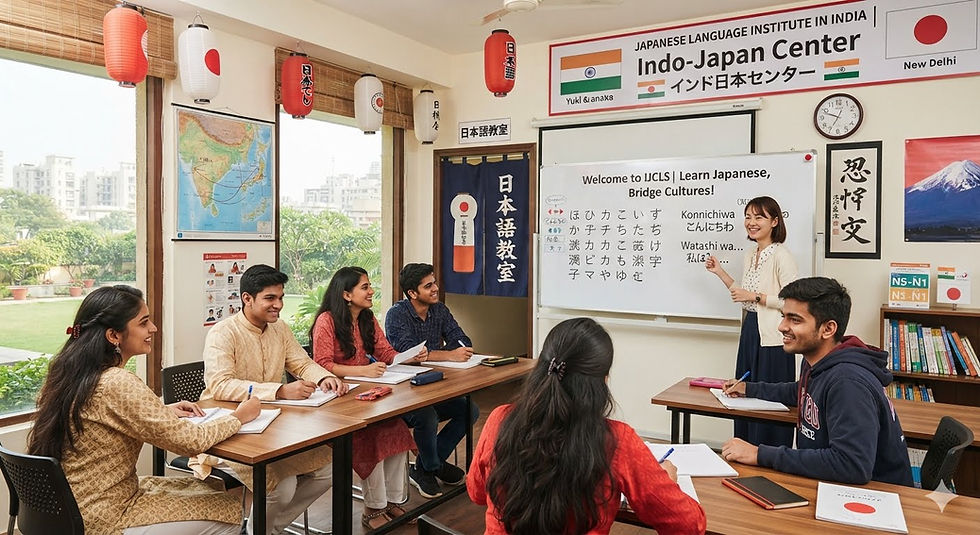
Achieving true Japanese fluency is more than memorising vocabulary or clearing an exam. It requires structured immersion, expert guidance, consistent speaking practice, cultural context, and a clear pathway from beginner levels to advanced proficiency. In India, the demand for Japanese language skills has surged dramatically. According to Japan Foundation data, the number of Japanese learners in the country rose from just over 5,000 in the early 2000s to nearly 53,000 by 2024. This growth is driven by expanding opportunities in Japanese companies operating in India, technical intern and specified skilled worker programmes, higher studies in Japan, and careers in IT, automobile, electronics, translation, tourism, and healthcare.
Choosing an expert Japanese language institute in India is the most reliable way to build
lasting fluency. The right institute does not stop at teaching textbook grammar. It systematically develops all four skills listening, speaking, reading, and writing while preparing students for the Japanese Language Proficiency Test (JLPT) from N5 to N1. Fluency emerges when learners move beyond rote learning into real conversation (kaiwa), business Japanese, keigo (honorific language), and cultural understanding.
What Defines an Expert Institute for Fluency
An expert Japanese language institute typically offers:
A complete JLPT-aligned curriculum covering N5 (beginner) through N1 (near-native).
Qualified faculty, preferably N1-certified Indian instructors with Japan exposure or native Japanese trainers for higher levels.
Small batch sizes that allow individual attention and speaking practice.
Regular mock tests, listening drills, and conversation sessions.
Placement support linking students to Japanese companies in India or opportunities in Japan.
Flexible modes offline classrooms, live online batches, and hybrid options to suit students and working professionals.
Institutes that focus only on exam tips without building conversational ability rarely produce fluent speakers. The best ones treat fluency as the primary goal and certification as the measurable outcome.
Popular Japanese Language Institutes in India
In other cities, options include Fuji Japanese Academy for comprehensive JLPT preparation and placement guidance, Saachi Japanese Language Institute in Bangalore known for conversation-focused training, Hayakawa Japanese Language School and Cultural Center in Chennai, and longer-standing programmes such as the Japanese Language School in Bangalore (established 1984). Online and pan-India providers like those associated with British School of Languages or specialised cultural schools also serve learners who prefer remote access while maintaining native-trainer input at intermediate and advanced levels.
These popular institutes share common strengths: transparent curricula, regular assessments, cultural components (calligraphy, film discussions, etiquette), and career counselling. Many now integrate guidance for Japan work visas, SSW/TITP pathways, and university applications, reflecting the practical motivations of most Indian students.
The Path to Fluency: From Classroom to Confidence
True fluency develops in stages. At N5 and N4, learners master hiragana, katakana, basic kanji, and everyday expressions. N3 builds intermediate communication and the ability to handle daily situations. N2 is widely regarded as the professional threshold sufficient for most roles in Japanese companies and many work visas. N1 represents advanced mastery suitable for specialised translation, interpretation, or academic work.
Expert institutes accelerate this journey through:
Intensive speaking practice rather than passive listening.
Progressive vocabulary and kanji targets (roughly 100 kanji at N5 rising to over 2,000 at N1).
Exposure to authentic materials news clips, business emails, workplace dialogues.
Continuous feedback that corrects pitch accent, particle usage, and natural phrasing.
Students who attend institutes with strong placement cells often gain additional motivation. Knowing that language skills can lead directly to roles as bridge engineers, coordinators, translators, or technical interns in Japan keeps learning purposeful.
Why India Is an Ideal Place to Learn Japanese Today
The India–Japan strategic partnership has deepened economic and educational ties. Japanese investment in manufacturing, infrastructure, and technology continues to create demand for bilingual professionals. Simultaneously, Japan’s demographic challenges have opened formal channels for skilled Indian talent. Language remains the key differentiator. An expert institute bridges the gap between classroom knowledge and workplace readiness, equipping learners with both the certificate and the confidence to communicate effectively.
Beyond careers, Japanese fluency opens doors to anime, literature, travel, and deeper cultural appreciation. Whether the goal is professional advancement or personal enrichment, structured learning under experienced teachers yields far better results than self-study alone.
Selecting the Right Institute
Prospective students should evaluate faculty credentials, batch size, student reviews, JLPT pass records, and support services. Visiting a demo class is highly recommended. Location matters for offline learners Delhi NCR, Bangalore, Pune, Mumbai, Chennai, and Kolkata host the densest concentration of quality centres while online options remove geographic barriers.
In summary, an expert Japanese language institute in India focused on fluency combines rigorous JLPT preparation with practical conversation skills, cultural insight, and career pathways. Popular institutes across the country have refined this model over years of experience, helping thousands of learners progress from absolute beginners to confident speakers. With the right guidance, Japanese fluency is an achievable and transformative goal for Indian students and professionals alike.


Comments